- Taking the 20,000 foot view on my class
- El Proyecto Personal: Creating Conversations, Taking Risks, Learning to Prepare for the World Outside the Classroom
- Notes I jotted to myself at the end of the term
- Let’s go bowling!
- Cooking with Drag Queens: Teaching Inclusion and Discovering the Limits of the Spanish Language
- Tune Up and a Smack down (part 2): The gringa returns to Bogotá
- A tune-up and a smack-down: The gringa returns to Bogotá
- Rethinking the role of the language textbook
- Our WordPress Class Blogging Tool: Now Yours Too
- A few shout outs and a woof
- Mid semester evaluation: Do it.
- What we did in class today, and no I can’t get you the notes.
- Searching for blogs in all the wrong places.
- Taking a tour of the HISP 205 class blog
- Syllabus Hacking with Bryan and the bava
- Social Networking and Octegenarians
- Reflections from the Chair Swing, Moving into the Summer
- The Backwards Syllabus
- Low hanging fruit
- VoiceThread as Final Exam
- Teaching outside of the textbook and inside of the museum
- Digital Storytelling and Language Learning
- Blogging their scholarship
- Why I teach.
- Professional development: Simple, small-scale, and cost-effective
- Teaching Transparently: Scuba diving in 2nd year college Spanish
- Ending the semester, Lessons Learned (Part 4: Assessment)
- Ending the semester, lessons learned (Part 3)
- Ending the semester, lessons learned (Part 2)
- Ending the semester, lessons learned (Part 1) … (of what will be many)
- Midterm assessment: My turn
- Informal Assessment, Disruption & Repair: Making change happen.
- What’s under the hood: letting the outside in
- Week 4: What? You don’t want me to write a paper?
- Welcome to the free fall
- Struggling with the Syllabus
- Imagining a college without grades
- Planning for HISP205-09… in Second Life
- Student-centered, project-based learning…and a medical emergency
- There is no mystery in grading
- Creating, Uploading, Commenting and Sharing Audio via SoundCloud
- Using Radio Ambulante in the Spanish language classroom
- Fear, Motivation, Social Consciousness and Language Learning: the graph
- Improvisational teaching
- Teaching Acceptance through Storytelling
- Creating Radio in the Language Classroom
- Well this is embarrassing
- Using Can-Do statements for student self assessment
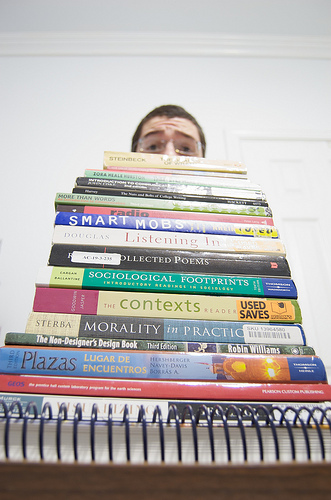
Photo credit: Marquette La on Flickr
This semester I am teaching the second semester, second year language class for Spanish. You know the class… the one that has all of the gnarly bits of grammar that were left over from the first semester of the second year sequence. The class where you will finally learn how to say “If you were a tree, what kind of tree would you be?” but not without reviewing (over and over again) the grammar and structures and forms and conjugations from the PREVIOUS semester or semesters.
The students coming into the class have already purchased the textbook, or textbooks (because there were THREE different books for this class, vs one huge textbook, all of which together cost each student about $150). Some of them may have already purchased access to the online components (videos, audio, more kill-and-drill exercises than you can shake an empanada at) The access to the online materials is good for three semesters.
I am expected to use the text, not because my department feels it is the best thing out there, but because we missed the window of opportunity to do anything different., and half the class bought the book for the first semester of the Intermediate sequence. (I believe that window of opportunity was open somewhere around March. In Ohio in March, it is really hard to think about anything other than “when will the winter END?!?!” … so here we are.)
I am not here to lambaste the textbook, nor the textbook industry. Lord knows I don’t want to write my own and I have tremendous respect for those who do. But textbooks, and the way they are structured, should not dictate the course’s or the students’ learning objectives.
The question is this: where do we want to end up at the end of this 16-week learning journey and how the heck are we going to get there?
As a way to organize my thoughts, I made a list of the chapter topics and a list of the grammar points each of those chapters covers. This is what I came up with:
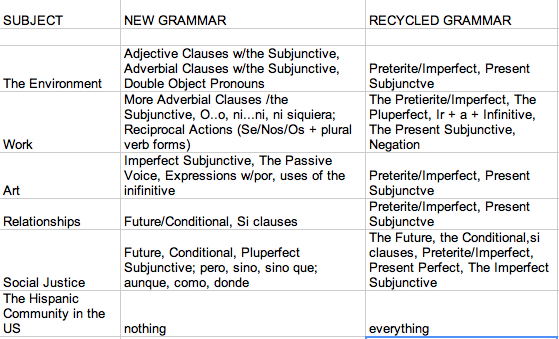
By the time we get to Chapter 12, it seems, there is nothing left to learn (!) What is more, the bulk of the semester seems to be about recycling and reusing knowledge acquired in previous semesters. Not surprisingly, students often complain in this class about not being challenged and how “we did this last year” or “we know this already” and now I can see why… there is more recycling happening this semester than actual new material to be learned.
So why not be upfront about this with the class from the get-go? Why not say: hey, look at this grid…here are the forms we have yet to learn, and here are the things we need to make sure we haven’t forgotten… but more important than that…(and here is where I move away from the textbook) here are some topics/themes that might be an interesting way to put those forms and functions into a useful context so we can use them to talk about things that matter, vs subjects the book hopes we care about.
There is this little event called a US Presidential election happening this fall and while I am teaching the class. That most certainly could lend itself to some active uses of the Present, the Past and the Subjunctive (“I want to vote for a candidate who…”) Some of the vocabulary that is (supposed to be covered) at the end of the semester should be incorporated sooner (the Hispanic Votes, issues involving Hispanics in the US, etc). The issue of same sex marriage is showing up on ballots more and more…. what better way to incorporate vocabulary about gender, relationships than here?
My point is this: Rather than going through the text in a sequential fashion (Chapter 1 must precede 2 which is always before 3…), I am going to think about larger, overarching topics that can connect the content of the chapters in more meaningful ways. Let’s take some vocab from chapter x and chapter y in order to talk or write about z. Let’s use the topics from the end of the book at the beginning of the semester and tie it into something that is going on in the world… that sort of thing.
Speaking of making things meaningful: I am also going to ask the students to tell me what they might like to do /say /accomplish with vocabulary that touches on Art, Work, The Environment, etc. How can this class make those topics more meaningful for them, and in turn for all of us as well? How can the grammar we are learning and re-learning be used to do that?
The text (and assorted ancillary materials) is as a resource….one of many resources, but not the only resource. This is not an either or kinda thing. More than anything I want my students to see that their own interests (as well as current events) can be woven into a language classroom, and if need be the text can take a back seat for a while. But it will be there…as a security blanket for some and a “justification for spending all this money” for others.
I welcome your thoughts and comments!


I enjoy your reflections on teaching. It does seem strange that we would not explicitly state what we expect students to be able to do as a result of the work we assign. Until I gained more familiarity with OPI proficiency guidelines, I used to think that textbooks, by definition, were the work aid that made such expectations explicit. By introducing dimensions like text type, circumlocution strategies, and functional taxonomies into the syllabus, I think we provide a more “active” matrix in which to integrate lexical items, syntactic stems, etc.
Other language programs could learn A LOT from ESL practitioners.
I like the Stanford SpanLang website because it offers up a detailed picture of what is expected of students at each phase of instruction framed in ACTFL’s “modes of communication” model. http://spanlang.stanford.edu
There is a lot at stake, frankly. I think misconceptions about language learning not only hinder learning, they also feed the “Learn it in an Hour” software market threatening language programs everywhere. Thanks for the thought post.
[…] is the very same class that I wrote about here. Sure, I could have just done what has been done before and forced the students to pay $200+ the […]
Joseph,
Apologies for the delay in my follow up comment. And thank you for the link to the work that Stanford’s Spanish Language department is doing. I am intrigued and will explore further.
Indeed, we have a lot to learn from ESL practitioners and how they prepare their students for the language that awaits them just outside the classroom. I have also wondered if this kind of language teaching might be found in Community Colleges and places where students learn languages for very practical purposes. And if they don’t, I wonder if they also are having a hard time breaking free from the “you need a textbook to learn” mindset.
I have a post in perpetual draft mode (it seems) about what you call the “Learn it in an hour” software market. Seriously now…why would someone assume you could learn a language in an hour…And why would they not assume the same, let’s say, for Chemistry or Calculus? Does anyone else see how erroneous this line of thinking might be? Not to mention how demeaning it is to those who DO know how hard it is, because they have out in the hard work and have done it…
Keep the comments coming!
Barbara
[…] know: I am not here to bash textbook companies. But as I have written before, they are problemmatic for numerous reasons. I continue to be worried about the image our texts portray of Hispanics and the hard work we need […]