- Taking the 20,000 foot view on my class
- El Proyecto Personal: Creating Conversations, Taking Risks, Learning to Prepare for the World Outside the Classroom
- Notes I jotted to myself at the end of the term
- Let’s go bowling!
- Cooking with Drag Queens: Teaching Inclusion and Discovering the Limits of the Spanish Language
- Tune Up and a Smack down (part 2): The gringa returns to Bogotá
- A tune-up and a smack-down: The gringa returns to Bogotá
- Rethinking the role of the language textbook
- Our WordPress Class Blogging Tool: Now Yours Too
- A few shout outs and a woof
- Mid semester evaluation: Do it.
- What we did in class today, and no I can’t get you the notes.
- Searching for blogs in all the wrong places.
- Taking a tour of the HISP 205 class blog
- Syllabus Hacking with Bryan and the bava
- Social Networking and Octegenarians
- Reflections from the Chair Swing, Moving into the Summer
- The Backwards Syllabus
- Low hanging fruit
- VoiceThread as Final Exam
- Teaching outside of the textbook and inside of the museum
- Digital Storytelling and Language Learning
- Blogging their scholarship
- Why I teach.
- Professional development: Simple, small-scale, and cost-effective
- Teaching Transparently: Scuba diving in 2nd year college Spanish
- Ending the semester, Lessons Learned (Part 4: Assessment)
- Ending the semester, lessons learned (Part 3)
- Ending the semester, lessons learned (Part 2)
- Ending the semester, lessons learned (Part 1) … (of what will be many)
- Midterm assessment: My turn
- Informal Assessment, Disruption & Repair: Making change happen.
- What’s under the hood: letting the outside in
- Week 4: What? You don’t want me to write a paper?
- Welcome to the free fall
- Struggling with the Syllabus
- Imagining a college without grades
- Planning for HISP205-09… in Second Life
- Student-centered, project-based learning…and a medical emergency
- There is no mystery in grading
- Creating, Uploading, Commenting and Sharing Audio via SoundCloud
- Using Radio Ambulante in the Spanish language classroom
- Fear, Motivation, Social Consciousness and Language Learning: the graph
- Improvisational teaching
- Teaching Acceptance through Storytelling
- Creating Radio in the Language Classroom
- Well this is embarrassing
- Using Can-Do statements for student self assessment
The lesson: Understand how to form and use comparisons of equality and comparisons of inequality. Figure out the superlative and how to use it. Learn all of the irregular forms. Make it make sense. Make it work. Have fun. Go.
The semester is winding to an end and I have just about had it with our textbook. The book chops up grammar into such staccato little bits of kibble that it is easy to see why an exhausted group of students, at the end of a semester, might just throw in the towel and give up. Language, when it is dissected and isolated and “chunked” as it tends to be in so many well-being but flawed textbooks, soon becomes lifeless and soul-less.
I think I have opened the book a total of three times this semester in class. I would have opened it more if students had specific questions or needed answers. But from the beginning of the term I told them: in class we will apply the grammar and use it in conversations and in context. They could use it as a guide for their take home exams. But in class? Let’s explore and go way outside of the text.
Our work as teachers, therefore, is to breathe life back into these tired texts and help our students find relevance and value in the forms they are being asked to master.
Enter: the ancillary materials.
Long ago, when my now teenage sons were infants, I moonlighted for a textbook company that needed writers to create ancillary exercises. Ever wonder why it is the workbook exercises seem to be written by someone other than the textbook authors? Well, at least back then, they were. The authors write the text and get their names on the cover. Meanwhile a small batallion of freelancers flesh out the exercises.
One of the oddest assignments I ever has was to take a series of 100+ foto flash cards — some of the strangest and less than complimentary fotos I have ever seen– that were left over from one textbook and then needed to be recycled and made to correspond with a new version of a different textbook.

This collection of images has followed me over the years and I bring them out to try and inspire conversation, commentaries and a few laughs. But this time of year? Ugh. I needed hard core inspiration for these tired, congested, overwhelmed estudiantes.
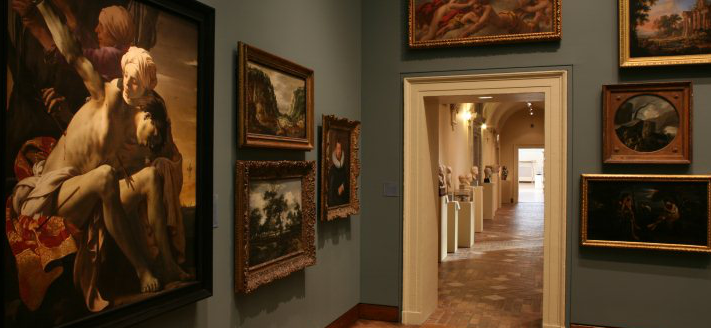
Enter: the college art museum.
Thanks to the wonderful efforts of our noble curator, Liliana Milkova (apologies for the previous typo!!), we were able to visit with several original and awesome works of art in the Museum Print Room that are a part of our museum’s collection but were normally tucked away in storage. They were taken out just for us.
Here is a link to the images my students were lucky enough to see and explore.
The assignment: Before you are a series of self portraits. Spend time with them, ask questions about them, talk with your classmates about them. Think about the stories they are trying to tell. Choose two (or more) and compare and contrast, using comparisons of equality, inequality, and the superlative. Choose works that inspire, intrigue, addle you. Write a 250 word, well-organized essay. Have fun.
The essays? They were incredible. It was the first time I have ever had students ask to exceed a word limit because “there is so much more I want to say.”
Lovely.
Their final exam will also involve the museum. At a time in the semester when everything seems to be swirling out of control, I have required them to sit and think, and reflect…in the quiet (and the beauty) of the museum.
Find a work in the permanent collection that interests you… it could be a painting, a sculpture, a print…whatever. Spend time with the work in the museum. Visit it. Look at it closely. Enjoy it. Take notes on it.
Elaboration:
Write a fairy tale / a story using your chosen artwork as its focus. If it is a fairy tale, begin with “Érase una vez….” (once upon a time)
Incorporate a wide variety of grammar we have covered to date in your story. Use your textbook as a guide. Be sure to use the past, present and future and the subjunctive mood in logical ways. Add perfect tenses when appropriate. Use past participles as adjectives. Add dialogue and incorporate commands where possible. Create something that you think is representative of your abilities in this class. Have fun.
Implementation:
Your final exam has two parts: (1) your written 1-2 page story and (2) a Voicethread recording of your story. (http://voicethread.com)
For part 2:
-Find a digital representation of your artwork here: http://rubens.cc.oberlin.edu/emuseum/ and upload it to Voicethread.
-Using either the video or the audio recording tool (or both!), tell your story.
-Read your work as if you were telling a story. Add inflection, enthusiasm.
-Have fun.
With their permission, their final voicethread projects will be posted on the AMAM’s website.
Comments?


Barbara, this is simply brilliant! I’m going to share it with all my colleagues in the Virtual Language Studies because your example has provided such a gateway to critical thinking and problem-based language learning. Thanks so much!
Thank you, Jan. You are very kind! I am always happy to share and even happier to know the stuff I might be doing here could be useful to someone somewhere else in world. That, to me, is what edublogging is all about….asking questions, sharing, and getting feedback.
Please ask your colleagues to leave a comment on here as to how it went for them as well. I would really like to know.
–B
I’m in awe. This is such a simple yet brilliant idea. I would have never thought of that. It is truly inspiring. The semester is winding down but I cannot wait to try it soon. Thank you for all your posts. They always make me re-think my own teaching and my students’ learning process.
Aww, thanks, Pilar.
Someone once told me that the hardest thing to know how to do as a teacher is to figure out when you should teach…and when you need to just get out of the way so your students can learn.
I think over time we have come to believe that books and ancillaries and exercises and quizzes and steamer trunks filled with multimedia blah dee blah (as well as tightly packed and compressed syllabi) are what we have to have in place and need to help students learn. We have turned teaching into juggling.
And on the whole, we aren’t very good jugglers.
We need to use this time between terms to stop…breathe…reflect on the craziness that our teaching has become. And to believe in the creativity and the imagination that our students inherently posses, but our current practices don’t make visible nearly enough…
I’ll let you know how the finals come out and may even post some of them here (with their permission, of course).
Wonderful, Wonderful. I opened my textbook 2 times so far this semester. I am really lapping up the assessment ideas on the blog these last weeks. I am so inspired I will moving voice thread assignments to vt take home exams for next semester. What I love about this assessment is the objective for language learners (all learners for that matter) getting right into the water, moving around and creating what they are able from what is available them. Note how different of an experience that is for each and every one of them. It leaves no learner style out as you never put them in the table box or otherwise. If our assessments should reflect what we are doing in class, this example you post invites many of us to really reflect on what we do in class- pitch the book and really revolutionize assessment strategies or follow the book and ask ourselves why they memorized the learned information for a successful test and can’t describe or narrate out of a paper bag. Thanks for the creative energy you continue to share with our field.
Thank you for your kind words, Colleen. It’s nice to know this site is being helpful in some way to others.
With regard to the textbook, I am afraid we can’t just pitch it, as much as we might like to. But it need not mean that every student has to purchase a copy for vast expense. I made sure there was a copy on reserve in my center that could be checked out (but not copied) so they could review things, check answers etc. No one complained (well maybe with the exception of the bookstore).
Next semester (part 2 of Intermediate Spanish) will be taught by someone else and she may insist that they have one. By then there SHOULD be used copies of the text available. We were one of the first classes to use the new version of the book…so of course previous versions while used were useless. Sigh, yet another reason to wait until used (and therefore more economical) texts become available.
It is important to note that the students we teach in higher ed have come to us with 12 years of traditional schooling under their belt and hard wired into their way of looking at “School.” To say “whoopee! no textbook!” might be just too much for some students. The trick is to provide them structure, but to make it clear that structure does not always require a text. That it is okay to deviate from the book, the workbook, the steamer trunk of ancillary blah-dee-blah and to listen to their needs/interests and then figure out a way to weave that into the content of the class.
And that even in the moments of total chaos and wackiness, we need to assure them that the class is flowing in a linear fashion, even if and when we make some prolonged pit stops to stop and smell the coffee now and again.
[…] To recap: this post talks about what I had asked them to do. […]
[…] To recap: this post talks about what I had asked them to do. […]