- Taking the 20,000 foot view on my class
- El Proyecto Personal: Creating Conversations, Taking Risks, Learning to Prepare for the World Outside the Classroom
- Notes I jotted to myself at the end of the term
- Let’s go bowling!
- Cooking with Drag Queens: Teaching Inclusion and Discovering the Limits of the Spanish Language
- Tune Up and a Smack down (part 2): The gringa returns to Bogotá
- A tune-up and a smack-down: The gringa returns to Bogotá
- Rethinking the role of the language textbook
- Our WordPress Class Blogging Tool: Now Yours Too
- A few shout outs and a woof
- Mid semester evaluation: Do it.
- What we did in class today, and no I can’t get you the notes.
- Searching for blogs in all the wrong places.
- Taking a tour of the HISP 205 class blog
- Syllabus Hacking with Bryan and the bava
- Social Networking and Octegenarians
- Reflections from the Chair Swing, Moving into the Summer
- The Backwards Syllabus
- Low hanging fruit
- VoiceThread as Final Exam
- Teaching outside of the textbook and inside of the museum
- Digital Storytelling and Language Learning
- Blogging their scholarship
- Why I teach.
- Professional development: Simple, small-scale, and cost-effective
- Teaching Transparently: Scuba diving in 2nd year college Spanish
- Ending the semester, Lessons Learned (Part 4: Assessment)
- Ending the semester, lessons learned (Part 3)
- Ending the semester, lessons learned (Part 2)
- Ending the semester, lessons learned (Part 1) … (of what will be many)
- Midterm assessment: My turn
- Informal Assessment, Disruption & Repair: Making change happen.
- What’s under the hood: letting the outside in
- Week 4: What? You don’t want me to write a paper?
- Welcome to the free fall
- Struggling with the Syllabus
- Imagining a college without grades
- Planning for HISP205-09… in Second Life
- Student-centered, project-based learning…and a medical emergency
- There is no mystery in grading
- Creating, Uploading, Commenting and Sharing Audio via SoundCloud
- Using Radio Ambulante in the Spanish language classroom
- Fear, Motivation, Social Consciousness and Language Learning: the graph
- Improvisational teaching
- Teaching Acceptance through Storytelling
- Creating Radio in the Language Classroom
- Well this is embarrassing
- Using Can-Do statements for student self assessment

To recap: this post talks about what I had asked them to do.
First realization: Next time I do this I think I will hand out a grid (similar to the one I used when listening to/ reading their work) to remind them to include all the necessary bits. I can see how easy it was for some to get wrapped up in the storytelling (which is great) but to lose track of why they were there (which sometimes wasn’t so good).
Most of the students did a great job. Some clearly ran out of time (or steam). Some didn’t read the directions. One student wrote an art history paper in Spanish (it was beautifully done but not what the assignment was about).
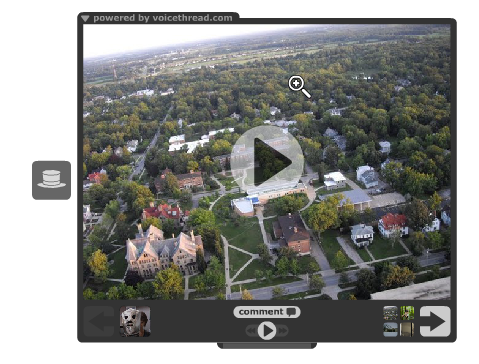
Each student wrote a story and handed in the text. They also used that text to narrate a VoiceThread production. What I wondered about was whether there would be a difference between just the written word and the narrated story with visuals. I thought there would not be much of a difference. I was wrong. (and happily so)
Here are two examples of the students’ work where the visual images and the narration they created greatly improved the story they were telling. Both went beyond what was asked of them and used additional images to add complexity and variety to the tale. I plan to use these two stories as examples for upcoming classes. While they did not receive similar grades, I thought their work was exemplary.
[N.B. Both students have given me their permission to post their work here]Student 1:


I totalled the number of necessary components (10). I included a point if the narration seemed fluid (vs being read from a script) and I included a point for what I call “chispa” or a spark. I divided the total number of points accumulated by the points possible (15).
This score was worth 70% of their final exam grade (the other 30% had been determined by their classmates in their group oral presentations). The final exam as a whole was 20% of their final (semester) grade.
No one element in the final was worth more than 15% of their final grade. Personally, I always hated it when final exams were the deciding factor in your final grade for a course. Some people just don’t test well, especially at the end of a long semester. For many of my students this was their first semester of college finals and I know they were nervous. I tried to be sensitive to all of those things when thinking about the weight of this exam and its impact upon their grade.
Comments?


Thanks for sharing these samples of student work with VT. I’m more and more attracted to using VT as a means of measuring students’ achievement of course goals, especially in intermediate and advanced language courses.
I really like the idea of using visual work from the college archive too. The samples seem to indicate that the students took interest in the assignment, and you get a good sense of their proficiency in Spanish in the final product.
My reservations are first, that students often narrate VT assignments from a script, and since they usually complete these projects on their own, it can be hard to measure their speaking proficiency. You mentioned this challenge in your post, so would it be more productive to have them complete the VT project during the final exam period or with the instructor’s supervision in the language lab? (This might also alleviate some technology problems, such as making sure students produce good quality voice/video recordings. I’ve struggled with this a bit.)
The second reservation comes from a long-standing concern of mine about how language students think and create with the target language. I’m all for creativity and even a bit of silliness, but it seems to me that many language students trivialize expression in the target language or imagine that the target language is a kind of fantasy world in which there are no limits or consequences to their expression. In short, we allow students to play pretend a lot in the target language, which is okay sometimes, but I want my students to know that Spanish is also a language in which millions of people express love, pain, and all kinds of mundane stuff every day.
For the assignment you gave your students, would it be possible for them to learn the stories behind the self-portraits they saw in the archives and the people who created those portraits? Might they be able to tell stories in VT from the perspective of those who created the works of art? I wonder if telling their stories from another perspective would not only demonstrate what they have learned in Spanish but also help them understand the real lives and desires that led to the creation of the art? This is just a thought based on my own concerns with some recent VT projects. Again, thanks for sharing. I’m grateful to have seen these examples — they’ll help me in planning my own courses.
Thanks for your comments and your suggestions!
I thought long and hard about the “script” part of the final exam/VT project. I wondered, as it sounds like you did as well, whether having the students write a script would upset the overall purpose of the oral narration that VT allows. Here’s my rationale for the text and then the narration:
1) I asked for some specific grammar bits to be included as part of the assignment. I think at this level of language learning it would have been hard for them to include those things “on the fly” and under the pressure of a final exam type situation. I wanted, therefore, to give them the opportunity to plan their talk and include all of the required components with time and without pressure.
2) I also asked them not to be wedded to the script when they told their stories. The two VTs I included here show students reading their work…but neither of them is reciting their work in a dry, boring, monotone. They are trying to put some chispa is there, some spark, some enthusiasm.
3) I ask them to read their papers before they hand them in because reading aloud helps you hear mistakes. Even at this level of language learning. Some students reported catching their errors while reviewing the recording, and going back and adjusting their text and their narrations. Yay.
I appreciate your concern about the students being disconnected from the language through activities such as these or in general. I think one way to get around this with something like VT is to post them (as I have done here) on a blog and ask native speakers to give them comments, not only on the use of the language but the message being conveyed. I have found that putting our students’ prose “out there” for the world to see yields remarkable results, and is a great first step to them writing, speaking and creating in the communities where the languages we teach are actively spoken.
With regard to the self portrait exercise: the curator gave us a wonderful explanation of the background of each of the works and what the artist was trying to say in each one. She helped us see the works not only in terms of the artist’s body of work but also his/her life story. The students included this information, as well as their own thoughts about the works, in their papers.
As mine was not an art history course, but a language course, I wanted them to have enough information to help them craft an essay describing the works. Sure, we could have turned the essay into a narrative from the perspective of the artist, but the task that week was a different set of grammar functions.
The museum trip was terrific because the art, and the stories behind the art, were captivating on many many levels. So yes, an excursion such as this could work on a variety of levels and for a variety of tasks.
So much more so than those flashcards I have toted around for years!
Keep your comments coming!
Barbara
Barbara-
Can you mail me offline. I have deleted your message to me a couple of months ago by accident. I would like to send you a few sample links… you will not believe these take home exams… I AM THRILLED